
Farrukh Zaman
Co-Founder and CTO (full-time)
Production systems at Cisco and Salesforce; product, architecture, and execution
 Parbat
Parbat
Find the price changes worth making — before customers see them.
We don't ask teams to trust a recommendation blindly. Parbat discovers opportunities, simulates business impact before customers are exposed, and ships only what's safe and worth doing — evidence before exposure.
Demand response is the unknown.
Margin leaks because teams are afraid to touch winners.
Brands cut price to move stock, even when it destroys gross profit.
Teams suspect a move is right, but lack the evidence to ship it.
The unanswered question is not “Can price affect profit?” It’s “What will demand do when this price changes?”
Parbat is the pre-exposure decision layer. Live testing remains available when experimental confirmation is worth the traffic and time.
Normalize pricing signals across traffic, conversion, margin, inventory, price history into a canonical pricing input.
Identify candidate price moves which are most likely to improve incremental gross profit using a demand-response model.
Convert those candidate prices into projected business impact before launch, using brand-calibrated simulated shopping sessions.
Launch only the price changes that are economically attractive, and safe. Every shipped move is backed by an Evidence Pack.
Capture realized outcomes from shipped price changes.
Feed measured outcomes back into scoring and simulation so future pricing decisions become more accurate, more reliable, and more brand-specific over time.
Models propose. Simulation estimates. Policy governs. Measurement recalibrates.
Every recommendation is backed by an Evidence Pack that shows Projected Impact, Verified Safety and Decision Context.
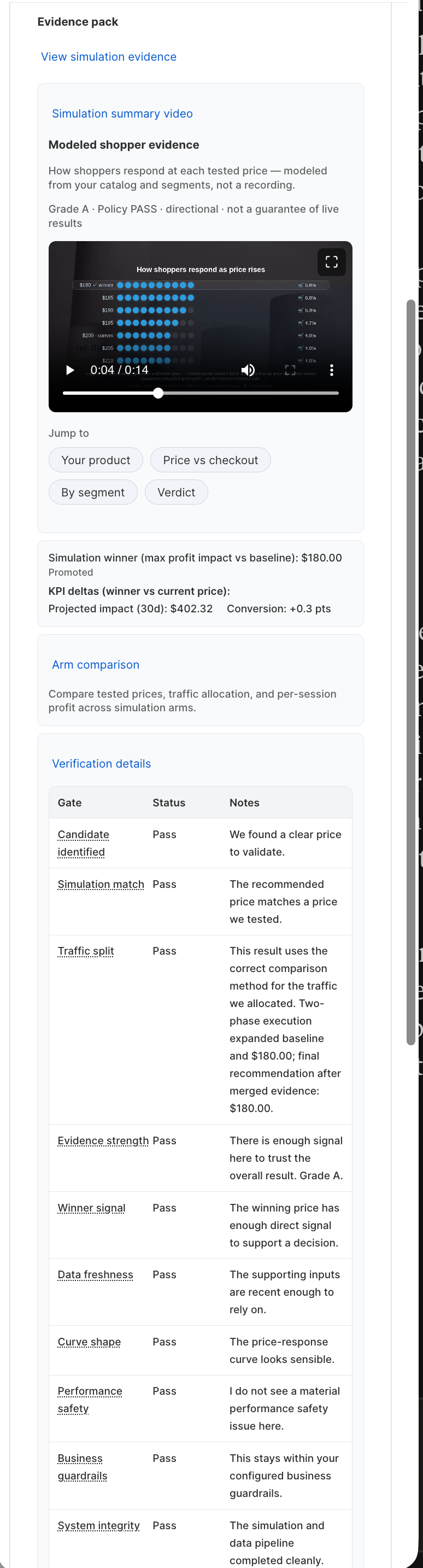
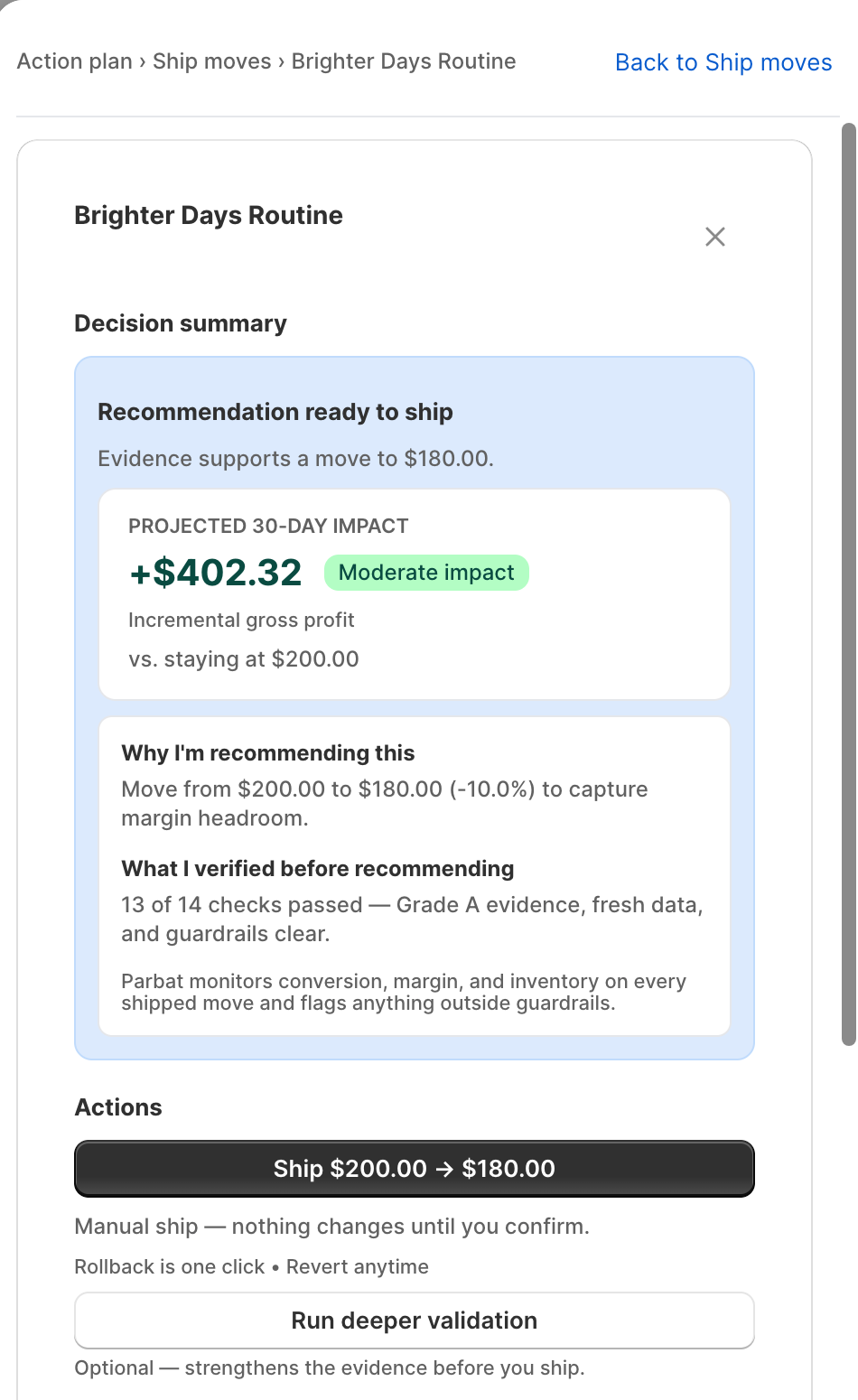
First projection-versus-outcome readout from our design partner lands: Oct. 2026
The missing layer is not another recommendation engine. It is a controlled system that simulates and governs changes before exposure.
Pre-exposure pricing decisioning is feasible now in a way it wasn’t a few years ago.
$2M–$20M in annual Shopify sales
15+ products each doing 20+ orders a month
40%+ gross margin on target products
Real price-change history across the catalog
80%+ of revenue through their own storefront
Founder, GM, or head of ecommerce can approve changes — including markdowns
We land with one narrow promise: help ship a small number of profitable, safe price changes quickly.
* Filtered for $2M–$20M Shopify revenue, order density (15+ products at 20+ monthly orders, proxied externally by store traffic), margin, and decision authority. Manually verified fit rate on a 100-store sample.
Expansion: Additional stores, catalog complexity, approval workflows, governance, and integrations
Annual SaaS subscription. No performance fee in the initial model.
Our go-to-market strategy focuses on a disciplined, three-stage approach to acquire and grow customer relationships.
Founder-led outreach to design-partner referrals, heads of eCommerce, and brands in the beachhead segment.
Generate measurable pricing wins and turn them into strong case studies with quantified impact.
Grow through a robust Shopify-native presence, partner agencies, and customer proof points.
Every shipped move creates a proprietary intervention record:
Parbat tracks forecast bias, error, and interval coverage by brand. As the system observes more interventions, brand-specific calibration should improve and uncertainty should narrow only where the evidence supports it.
A new provider can access historical orders. It does not inherit Parbat's exact projection, policy, approval, rollback, and outcome lineage—or the calibrated model state produced by those interventions.
The moat exists only if calibration error improves with use. We measure that directly.
Parbat starts with Shopify pricing because pricing is frequent, high-leverage, measurable, and under-operationalized. But the core system is not limited to price changes.
Predict the outcome of proposed commercial actions before they go live.
Ensure changes align with business guardrails and policies.
Launch only what is economically attractive and validated.
Continuously refine models based on realized results.
That same loop can extend from pricing into promotions, markdowns, merchandising, inventory, and other profit-sensitive commerce decisions.
We're building simulation-led decision infrastructure for commerce — starting with pricing, and expanding only where the economics can be measured.
Parbat did not start as a generic AI pricing idea. We spent the last three years embedded with a live design partner, observing how pricing decisions were actually made in practice: too much manual judgment, too little evidence, and no safe path to ship.
That led us to a specific conviction: brands do not need more pricing analytics. They need a system that helps them evaluate, verify, and ship pricing decisions with confidence.
Co-Founder and CTO (full-time)
Production systems at Cisco and Salesforce; product, architecture, and execution

Co-Founder (advisory → full-time post-raise)
Research, commercial strategy, measurement, and GTM experience from Dynata and Ipsos
This is not a market thesis we formed from the outside. It's a decision process we learned firsthand and built into software.
The next financing milestone: measured, repeatable pricing outcomes across brands.
Appendix available on request — simulation architecture, measurement methodology, market-sizing method, beta design.
connect@parbat.ai · www.parbat.ai/contact